

Addressing challenges in nanostructure fabrication
Nanostructure fabrication plays a pivotal role in material science, driving advancements in photonics, microelectronics, and sensing technologies. One of the most accurate methods for creating nanoscale patterns is ultraviolet laser interference lithography (LIL), which leverages coherent light sources to produce highly precise designs.
However, as researchers aim to create increasingly complex and smaller structures, the limitations of current laser systems — such as resolution, wavelength instability, and energy efficiency — become significant barriers. These challenges directly impact the development of next-generation technologies, including quantum computing, ultra-efficient solar cells, and molecular-level sensors — slowing progress in fields that depend on breakthroughs at the nanoscale. Overcoming these limitations is critical to unlocking the full potential of nanotechnology in shaping the future of energy, healthcare, and information processing.
At the Interdisciplinary Centre for Materials Science (IZM) of Martin-Luther-Universität Halle-Wittenberg, a 266 nm ultraviolet laser had long been central to their research. While effective for producing patterns with periods ranging from 150 nm to 650 nm, this system struggled with:
-
Limited period range: Structures with periods between 650 nm and 1000 nm were unattainable.
-
Photoresist compatibility: The limited range of compatible resists at 266 nm restricted design flexibility and innovation.
To overcome these challenges, the IZM tested the Skylark 349 NX, a 349 nm ultraviolet diode-pumped solid-state (DPSS) laser. With a wavelength closer to the Hg-i line and enhanced beam stability, this laser demonstrated its potential to expand the capabilities of interference lithography.
Features of the Skylark 349 NX ultraviolet laser for interference lithography
The Skylark 349 NX laser evaluated by the IZM is a 100 mW ultraviolet DPSS laser designed for high-precision applications. The advanced ultra-stable monolithic design, available in power output up to 400 mW, enables it to address key limitations in existing LIL setups.
-
Ultra-stable wavelength at 349 nm: Closer proximity to the Hg-i line (365 nm) improves access to wider variety of photoresists.
-
High power stability: A consistent 100 mW power output ensures uniform exposure, critical for creating high-precision interference patterns.
-
Long coherence length: Enables the development of sharper, well-defined structures.
-
Exceptional beam quality: The well-defined beam profile and alignment precision allow the laser to focus through a 10 µm pinhole without deviation, maintaining accuracy in patterning.
-
Thermal management: An integrated cooling system (maintained at 19°C) ensures long-term operational stability.
These features make the Skylark 349 NX uniquely suited for advanced laser interference lithography, enabling both precision and reproducibility in interference patterning.
Expanding lithographic capabilities with the Skylark 349 NX
The Skylark 349 NX was integrated into a Lloyd’s interferometer setup during a four-week testing period at the IZM. This configuration splits the laser beam to create interference patterns, with the period of these patterns adjusted by modifying the angle of incidence. The laser’s stable and coherent light source was critical for achieving consistent results.
Key outcomes:
-
Successful creation of structures with periods between 650 nm and 1000 nm, previously unattainable with the 266 nm system.
-
Enabled customisable and repeatable designs for photonic crystals, diffraction gratings, and meta surfaces, vital for optical applications like sensors and filters.
-
Enhanced resist thickness with exposed resist layers up to 1.4 µm.
-
Enhanced performance with industry-standard resists like AZ 5214E and AZ MIR 701, producing high-aspect-ratio features with fine detail.
Precision line gratings and customisable features:
The Skylark 349 NX demonstrated its versatility by producing high-precision line gratings and customisable features across a range of periods and photoresists:
High-resolution line gratings:
-
Small-period gratings: Ideal for high-resolution hard masks used in silicon etching.
-
Intermediate-period gratings: Suitable for lithographic designs requiring high-aspect-ratio features.
-
Large-period gratings: Effective for optical applications like beam splitters and large-scale patterning.
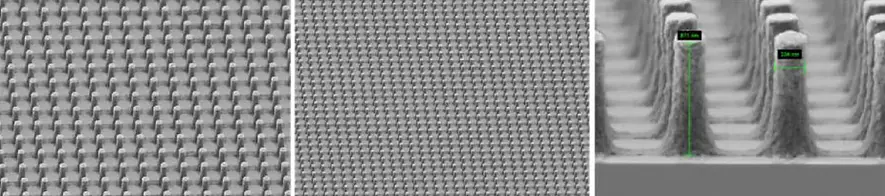
High-aspect ratio structures and complex patterning developed using the Skylark 349 NX
Custom features and design flexibility:
-
High-aspect-ratio features critical for applications requiring robust, precise, and durable patterns.
-
Square pillar arrays with consistent geometries, suitable for advanced lithographic designs in optical or electronic applications.
-
Sinusoidal gratings with highly detailed structures suitable for a wide range of optical, sensing, and communications applications.
-
Trench and bridge widths are controlled by adjusting exposure times.
-
Slanted / tilted lines are achieved by rotating the sample.
Applications of ultraviolet DPSS lasers in interference lithography
The Skylark 349 NX ultraviolet DPSS laser delivers exceptional precision, stability, and coherence to enable advancements in various applications:
-
Nanoimprint lithography masters
-
High efficiency gratings for spectrometry and telecommunications
-
Nano-patterns to enhance the reflectivity of surfaces
-
Creating surfaces that amplify Raman spectra (SERS)
-
Optics including beam splitters, waveguides, and meta surfaces

